
Fixture Replacements in Easton: Should Every Finish Match?
Decide whether to match existing fixture finishes or mix metals deliberately, with a practical plan for keeping sound pieces and replacing visual outliers.

Matching Is an Option, Not a Requirement
Fixture replacements in Easton do not require every visible metal finish to match. A coordinated room can use one finish throughout, or combine finishes with enough repetition to make the contrast look intentional. The useful question is not whether chrome can sit beside brass. It is whether replacing everything would improve the room more than keeping sound pieces and changing the few items that feel disconnected.
Start with the appearance you want and a clear boundary around the work. A new faucet changes that fixture; it does not update the mirror, repair damaged tile, or improve the room's layout. Likewise, replacing accessories can establish a finish pattern without changing plumbing fixtures. Separating those decisions helps homeowners avoid turning a small visual update into a larger project without a clear reason.
Map the Finishes You Actually See Together
Before shopping, stand at the doorway and note which metal pieces appear together. In a bathroom, the faucet, drain, mirror frame, towel ring, and shower trim may share one view. In a kitchen, the faucet may be seen alongside cabinet pulls and pendant lights. These sightlines matter more than whether an isolated handle elsewhere in the house has the same finish. Take photographs from normal standing positions rather than inspecting each item alone.
Also check what you see while using the room. A mirror may reflect shower trim that is otherwise out of view, making it part of the same composition. In a shared bathroom, appearance decisions should leave practical arrangements intact; planning a shared bathroom for busy mornings addresses that separate concern. Finish coordination cannot compensate for poor access to storage, awkward towel placement, or competing use of one basin.

When Replacing the Whole Visible Group Makes Sense
Matching finishes is useful when you want the metalwork to recede rather than become a feature. Repeating brushed nickel across a faucet and nearby accessories can make a compact vanity area feel visually settled. It can also simplify selection when the room already contains patterned tile or strongly veined surfaces. This is an appearance choice, however, not a reason to discard every functional piece automatically.
Replacing all visible pieces becomes more reasonable when several are worn, the existing finishes are inconsistent, and no retained item gives the room a useful starting point. Count the full group before deciding. A faucet-only purchase can leave the drain and accessories looking unexpectedly different. If cabinet work is also planned, settle storage needs through cabinet replacement planning before choosing matching pulls; hardware color does not determine whether the cabinets serve their purpose.
When Keeping Sound Pieces and Mixing Finishes Works
A mixed-finish scheme works best when the differences have a readable pattern. One approach is to retain chrome plumbing fixtures and repeat black on a mirror frame and towel accessories. Another is to keep brushed-nickel fixtures while using brass accents in a separate lighting group. Two clearly distinguishable finishes are often easier to organize than several almost-matching silvers. Neither finish needs to appear in exactly equal amounts across the room.
Give each finish a job instead of scattering it randomly. Plumbing fixtures might form one group, with mirrors and accessories forming another. Repetition can help a secondary finish look deliberate, although there is no universal number of pieces required. Start with what is worth retaining, then replace an isolated outlier if it interrupts that pattern. A single brass towel ring surrounded by otherwise coordinated chrome may need attention; the entire room may not.
Compare Sheen Along With Color
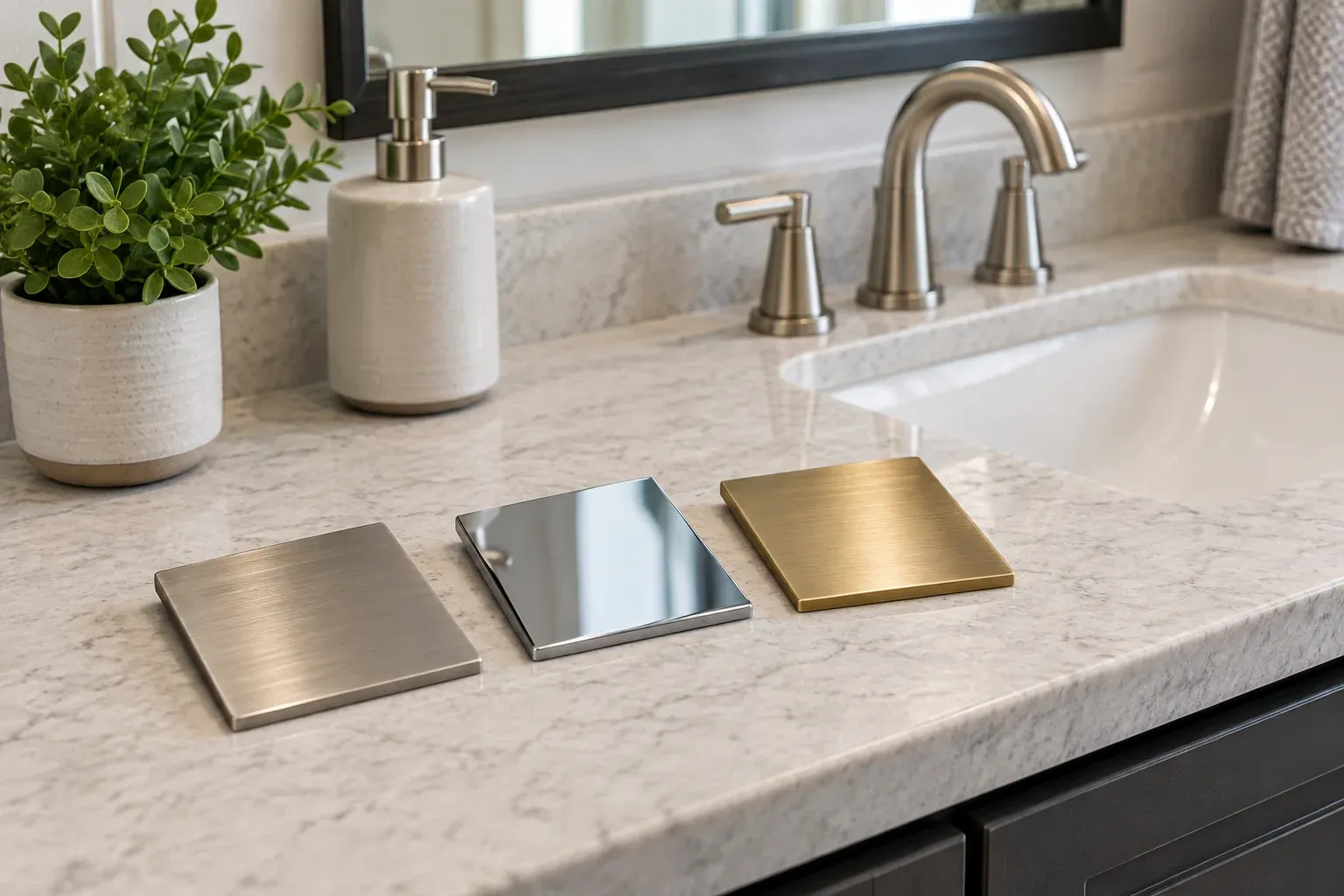
Color is only part of the comparison. Polished surfaces reflect more distinct highlights, while brushed or satin surfaces scatter light and look softer. Two silver-toned pieces can therefore look quite different even when their basic color is close. Finish names alone are not reliable matching tools: products described as brushed nickel or satin brass can vary between manufacturers, collections, and production runs. Compare the actual appearance whenever possible.
The surrounding materials also affect the choice. A warm countertop may make a cool metal stand out, while a dark mirror frame can emphasize other dark accents. If new counters are part of separate work, countertop seam planning addresses fabrication decisions, not fixture coordination. Establish the main surface selections before finalizing metal samples so you are judging the complete combination rather than expecting a faucet finish to resolve unrelated surface details.
Judge Samples in the Actual Room
Bring physical samples or returnable products into the actual room when practical. Hold them near the retained fixture, then step back to the doorway. Compare them in daylight and under the lights normally used in the evening. A sample that looks close on a store display may look warmer, darker, or shinier beside your existing pieces. Phone photographs help record options, but screens are not dependable tools for judging subtle finish differences.
Test both strategies before ordering a full set: one sample that closely coordinates with the retained finish, and one that creates an obvious contrast. Place each against the same tile, paint, and countertop. Then ask which option makes the remaining pieces look intentional. Check the product's care instructions too, particularly where different coatings would require different cleaners. A pleasing combination should also be manageable for the people maintaining the room.
Write a Keep-or-Replace Plan Before Ordering
Turn the chosen look into an itemized keep-or-replace schedule. Record each piece, its condition, its existing finish, and the intended replacement if needed. Separate appearance from compatibility: a matching faucet still needs to suit the sink and installation. The guide to faucet fit covers that different decision. Also distinguish fixture replacement from accessory changes, electrical work, or surface repairs so the written scope does not imply they are interchangeable.
For an office restroom or tenant space, record who selects, purchases, and approves each item; deciding who supplies what helps prevent mismatched substitutions. Use the same discipline at home, including finish identifiers rather than color names alone. The best plan for fixture replacements in Easton is the smallest clearly defined scope that achieves your chosen appearance while retaining suitable pieces. Match everything when it serves that goal; mix finishes when the existing room gives you a sound starting point.
- Keep: sound pieces that support the selected finish scheme.
- Replace: worn pieces or visual outliers that undermine the scheme.
- Confirm separately: product compatibility, installation requirements, and any adjacent work.
Frequently asked questions
Should every metal finish in a bathroom match?
No. Matching finishes can create a quiet, unified appearance, while a mixed scheme can work when each finish has a clear role. Judge the pieces visible together rather than requiring every metal item in the home to match.
Can I keep a chrome faucet and add black accessories?
Yes, as an appearance choice. Repeating black in a mirror frame and towel accessory can make the contrast look deliberate. Keeping the faucet and visible drain coordinated can also give the basin area a consistent appearance.
Does the same finish name guarantee a match across brands?
No. Color, sheen, texture, and protective coatings can differ. Compare physical samples or actual products beside the retained fixture in the room before committing to replacements.